




-
admin
- December 16, 2025
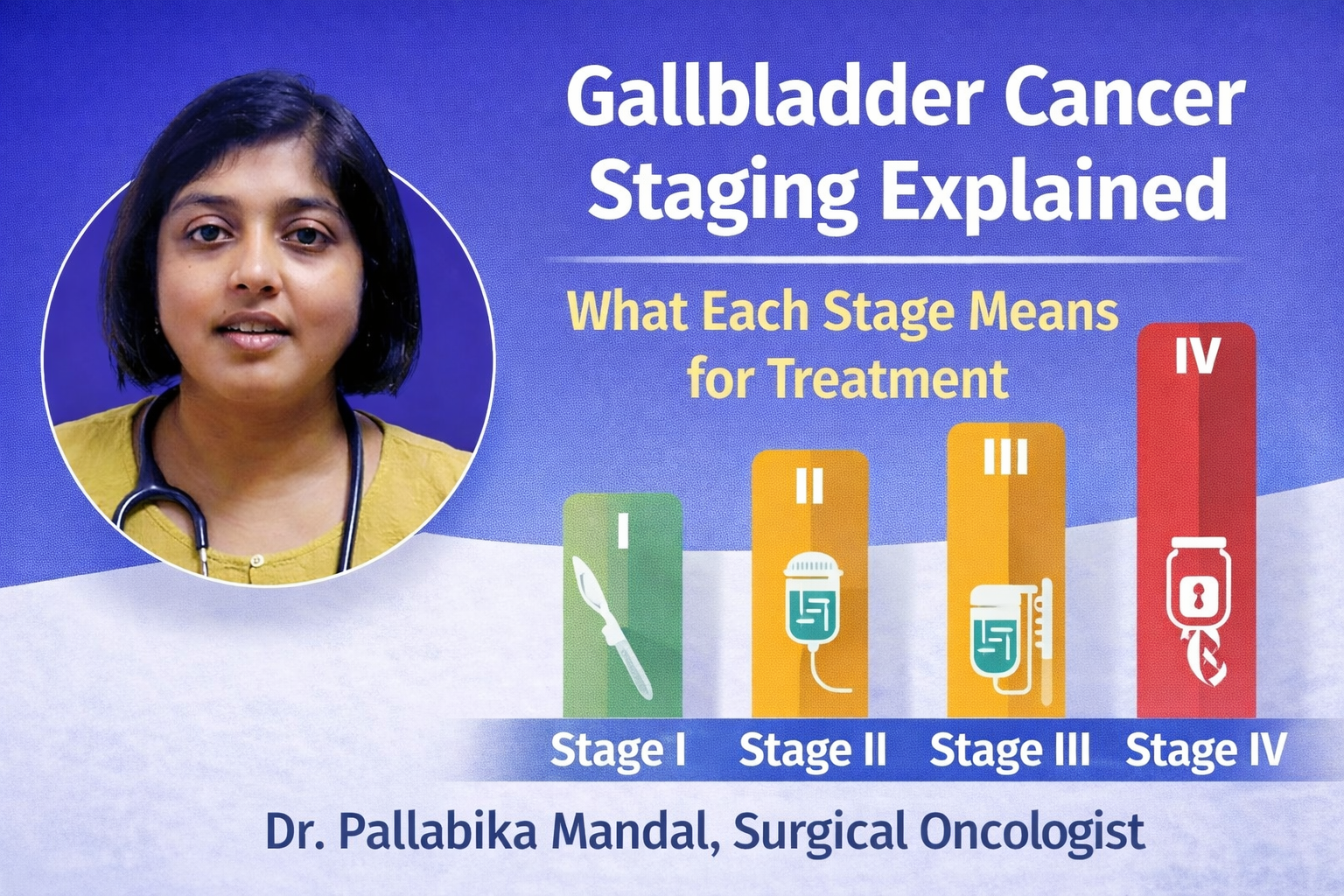
Gallbladder Cancer Staging Explained: What Each Stage Means for Treatment
When someone is diagnosed with gallbladder cancer, one of the first terms they hear is “stage”. For patients and families, this single word often brings confusion, fear, and many unanswered questions.
- What does Stage I or Stage IV really mean?
- Does staging decide whether surgery is possible?
- Can treatment outcomes change based on stage?
Understanding gallbladder cancer staging is essential because every treatment decision—especially surgery—depends on it.
As a Surgical Oncologist trained at AIIMS, New Delhi, Dr. Pallabika Mandal carefully evaluates cancer stage before recommending surgery, chemotherapy, or supportive care. Incorrect staging can lead to unnecessary surgery or missed treatment opportunities.
This guide explains gallbladder cancer staging in clear, simple terms, and how each stage affects treatment options for patients in Kolkata and Eastern India.
For a complete overview of gallbladder cancer symptoms, diagnosis, and treatment approaches, patients may also refer to
👉 Gallbladder Cancer Treatment in Kolkata
https://drpallabikamandal.com/gallbladder-cancer/
What Is Cancer Staging and Why Is It Important?
Cancer staging describes:
- How deep the cancer has grown
- Whether it has spread to nearby organs
- Whether distant organs are involved
In gallbladder cancer, staging helps doctors decide:
- Whether surgery is possible
- What type of surgery is needed
- Whether chemotherapy or radiation is required
- What the realistic outcome may be
Unlike many cancers, gallbladder cancer spreads early, which makes accurate staging absolutely critical.
How Gallbladder Cancer Is Staged
Gallbladder cancer is staged using the TNM system:
- T (Tumor): How deeply the tumor has invaded the gallbladder wall
- N (Nodes): Whether nearby lymph nodes are involved
- M (Metastasis): Whether cancer has spread to distant organs
These factors combine to determine Stage I to Stage IV.
Stage I Gallbladder Cancer – Very Early Disease
What Happens in Stage I
- Cancer is limited to the gallbladder wall
- No lymph node involvement
- No spread to liver or other organs
Why Stage I Is Rare
Gallbladder cancer at this stage usually causes no symptoms and is often discovered accidentally during gallstone surgery.
Treatment Approach
- Surgery offers the best chance of cure
- In some cases, gallbladder removal alone may be enough
- Additional surgery may be advised depending on biopsy results
Prognosis
This stage has the highest survival rate if treated properly.
Stage II Gallbladder Cancer – Localized but Deeper Spread
What Happens in Stage II
- Cancer has invaded deeper layers of the gallbladder
- No distant spread
- Lymph nodes are not involved
Symptoms
- Persistent right upper abdominal pain
- Indigestion
- Occasionally weight loss
Treatment Approach
- Radical gallbladder surgery is recommended
- Surgery includes:
- Gallbladder removal
- Removal of part of the liver
- Removal of nearby lymph nodes
Dr. Pallabika Mandal emphasizes that simple gallbladder removal is not enough at this stage.
Prognosis
Good outcomes are possible with timely surgery and proper oncologic technique.
Stage III Gallbladder Cancer – Locally Advanced Disease
What Happens in Stage III
- Cancer spreads to:
- Nearby liver tissue
- Regional lymph nodes
- No distant organ metastasis
Why Stage III Is Complex
This is a borderline stage, where treatment decisions must be individualized.
Treatment Approach
- Surgery may still be possible in selected patients
- Often preceded by chemotherapy to shrink the tumor
- Careful reassessment before surgery is essential
This stage is discussed in detail in the expert guide
👉 When Is Surgery Necessary for Gallbladder Cancer?
Prognosis
Outcomes vary depending on:
- Tumor response to chemotherapy
- Extent of liver involvement
- Overall patient health
Stage IV Gallbladder Cancer – Advanced or Metastatic Disease
What Happens in Stage IV
- Cancer spreads to:
- Multiple liver areas
- Lungs
- Peritoneum (abdominal lining)
- Distant lymph nodes
Symptoms
- Jaundice
- Severe weight loss
- Fatigue
- Abdominal swelling
- Loss of appetite
Treatment Approach
- Surgery is usually not recommended
- Chemotherapy is the main treatment
- Focus is on symptom relief and quality of life
Performing surgery at this stage does not improve survival and may increase complications.
Why Accurate Staging Is Often Missed
Gallbladder cancer is frequently under-staged because:
- Early imaging may miss microscopic spread
- Symptoms mimic gallstones
- Emergency gallbladder surgeries may skip staging
This is why Dr. Pallabika Mandal follows a structured staging protocol, including:
- Contrast-enhanced CT or MRI
- Liver function assessment
- Tumor marker evaluation
- Diagnostic laparoscopy in selected cases
Incidental Gallbladder Cancer: When Stage Is Discovered Late
In such cases:
Sometimes cancer is found after gallbladder surgery for stones. This is called incidental gallbladder cancer.
Gallstones vs Gallbladder Cancer: How to Tell the Difference Early
- The stage is reassessed
- Further surgery may be required
- Treatment depends on tumor depth and spread
How Staging Affects Survival and Outcomes
| Stage | Surgery Possible | Treatment Goal |
|---|---|---|
| Stage I | Yes | Cure |
| Stage II | Yes | Cure |
| Stage III | Sometimes | Disease control |
| Stage IV | No | Symptom relief |
Early staging leads to better decision-making and improved outcomes.
Common Myths About Gallbladder Cancer Staging
Myth: “Stage IV means nothing can be done”
✔ False. Treatment can still control symptoms and improve quality of life.
Myth: “Stage I doesn’t need follow-up”
✔ False. Regular monitoring is essential.
Myth: “All stages are treated the same”
✔ False. Treatment is stage-specific.
When Should You Ask About Cancer Stage?
You should ask your doctor about staging if:
- Gallbladder cancer is suspected
- Surgery has been advised
- Cancer was found after gallstone surgery
- Chemotherapy is planned
Understanding your stage empowers you to make informed decisions.
Expert Evaluation with Dr. Pallabika Mandal
Dr. Pallabika Mandal
M.Ch (Surgical Oncology), AIIMS New Delhi
Specialist in Gallbladder & GI Cancers – Kolkata
She provides:
- Accurate staging
- Evidence-based treatment planning
- Honest guidance on surgery suitability
Frequently Asked Questions (FAQs)
1. Can gallbladder cancer stage change over time?
Yes. Cancer may progress if untreated.
2. Is biopsy always required for staging?
Not always. Imaging often provides sufficient information.
3. Can Stage III cancer become operable?
Sometimes, after chemotherapy.
4. Does staging affect chemotherapy choice?
Yes. Treatment plans depend heavily on stage.
5. Should staging be re-checked before surgery?
Yes. Restaging prevents unnecessary operations.