




-
admin
- January 15, 2026
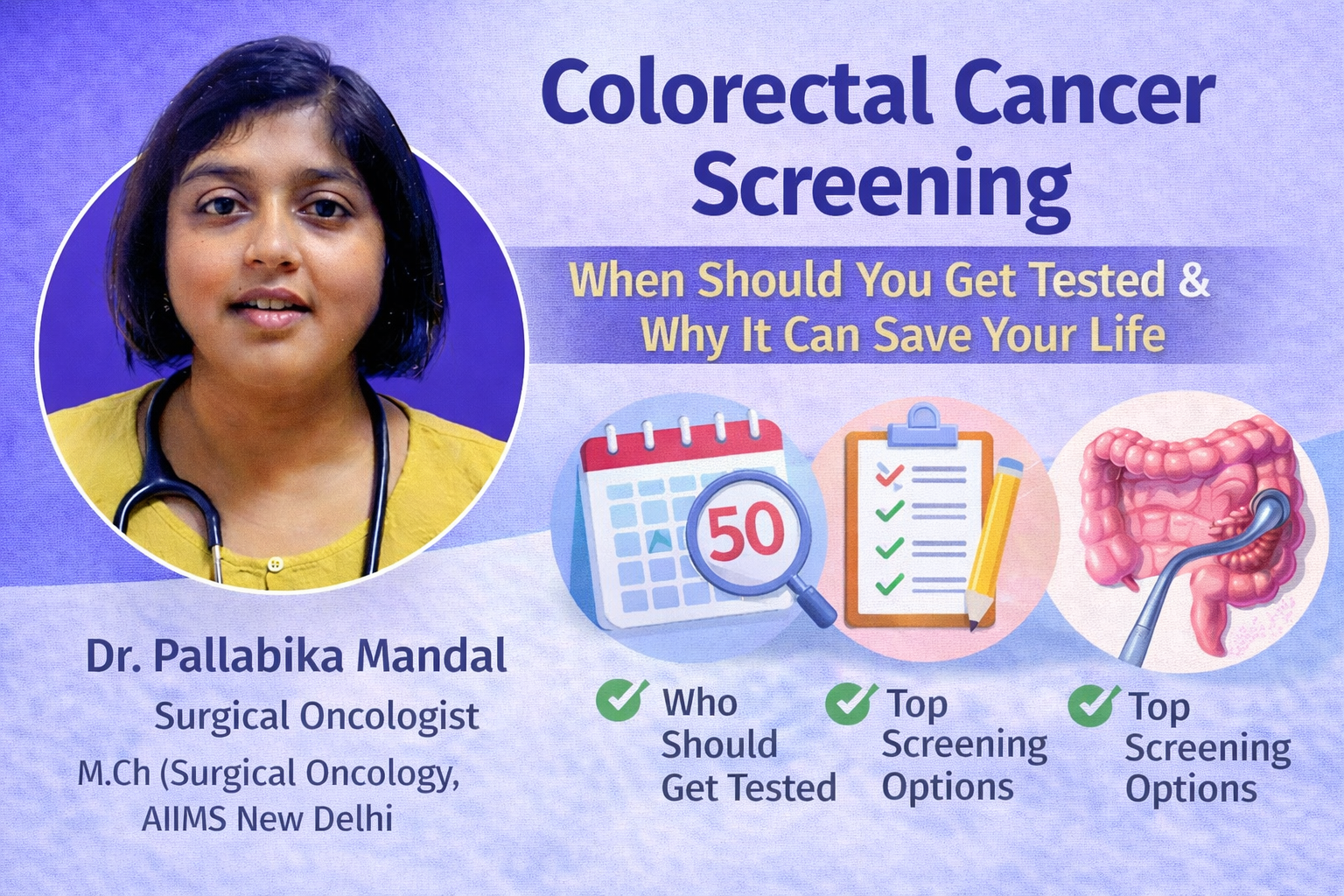
ColorectalCancer Screening: When Should You Get Tested and Why It Can Save Your Life
Colorectal cancer—affecting the colon and rectum—is one of the most preventable yet frequently diagnosed cancers worldwide. In India, and particularly in urban centres like Kolkata, cases are rising steadily due to changing dietary habits, sedentary lifestyles, and delayed medical consultation.
What makes colorectal cancer especially dangerous is not its aggressiveness alone, but the fact that early stages often cause little or no symptoms. By the time warning signs become obvious, the disease may already be advanced.
As a Surgical Oncologist trained at AIIMS, New Delhi, Dr. Pallabika Mandal strongly emphasises timely colorectal cancer screening, especially for individuals with risk factors. Early detection not only improves survival rates but can often prevent cancer altogether.
This guide explains who should get screened, when screening should begin, what tests are available, and why early testing saves lives.
What Is Colorectal Cancer?
Colorectal cancer begins in the lining of the colon or rectum, usually as small growths called polyps. These polyps are often benign initially but can gradually turn cancerous over several years.
The key point is:
👉 Most colorectal cancers are preventable if polyps are detected and removed early.
Why Colorectal Cancer Screening Is So Important
Unlike many cancers, colorectal cancer gives doctors a unique advantage:
- A long pre-cancerous phase
- Reliable screening tests
- Clear treatment pathways when detected early
Benefits of screening:
- Detects cancer before symptoms appear
- Identifies and removes polyps before cancer develops
- Reduces mortality significantly
- Allows minimally invasive treatment
Dr. Pallabika Mandal often explains to patients that screening is not about fear—it’s about control and prevention.
Who Should Get Screened for Colorectal Cancer?
1. Average-Risk Individuals
People with no symptoms and no family history should begin screening at:
🟢 Age 45–50 years
Even without symptoms, screening is recommended because early cancer is often silent.
2. High-Risk Individuals (Earlier Screening Needed)
You may need earlier or more frequent screening if you have:
- Family history of colorectal cancer
- History of colon polyps
- Inflammatory bowel disease (ulcerative colitis or Crohn’s disease)
- Obesity
- Diabetes
- Smoking or heavy alcohol use
In such cases, screening may begin as early as age 35–40, depending on risk profile.
Common Symptoms That Should Prompt Immediate Testing
Even if you are younger than screening age, testing is essential if you experience:
- Persistent constipation or diarrhoea
- Blood in stool or rectal bleeding
- Change in stool shape or calibre
- Unexplained weight loss
- Fatigue or anaemia
- Feeling of incomplete bowel emptying
Symptoms lasting more than 2–3 weeks should never be ignored.
Types of Colorectal Cancer Screening Tests
1. Colonoscopy (Gold Standard)
A colonoscopy allows direct visualisation of the colon and rectum using a flexible camera.
✔ Detects cancer and polyps
✔ Allows removal of polyps in the same procedure
✔ Long screening interval if normal
Dr. Pallabika Mandal recommends colonoscopy as the most comprehensive screening tool, especially for high-risk individuals.
2. Flexible Sigmoidoscopy
Examines the lower part of the colon.
✔ Less invasive
✖ Does not evaluate the entire colon
Often combined with stool tests.
3. Stool-Based Tests
These detect hidden blood or abnormal DNA in stool.
✔ Non-invasive
✔ Useful for average-risk screening
✖ Positive results still require colonoscopy
4. CT Colonography (Virtual Colonoscopy)
Uses CT imaging to view the colon.
✔ Non-invasive
✖ Cannot remove polyps
✖ Colonoscopy needed if abnormalities are found
How Often Should Screening Be Done?
- Normal colonoscopy: Every 10 years
- Polyps detected: Interval depends on type and number
- High-risk patients: More frequent surveillance
Screening schedules are personalised based on findings and risk factors.
What Happens If Polyps Are Found?
Polyps are classified based on:
- Size
- Number
- Histology (microscopic features)
Many polyps are removed during colonoscopy itself, preventing future cancer.
This is why screening is not just diagnostic—it is preventive.
What If Cancer Is Detected During Screening?
Early-stage colorectal cancer detected during screening often allows:
- Curative surgery
- Minimally invasive approaches
- Reduced need for chemotherapy
- Excellent long-term outcomes
Dr. Pallabika Mandal highlights that patients diagnosed through screening generally have far better outcomes than those diagnosed after symptoms appear.
Common Myths About Colorectal Cancer Screening
❌ “I don’t have symptoms, so I don’t need screening”
→ False. Early cancer is often asymptomatic.
❌ “Screening is painful”
→ Modern techniques are safe and comfortable.
❌ “Colorectal cancer only affects men”
→ False. Women are equally at risk.
❌ “I’m too young”
→ Increasing cases are being seen in younger adults.
Preparing for a Colonoscopy: What Patients Should Know
Preparation usually involves:
- Temporary dietary changes
- Bowel-cleansing medication
Though preparation may feel inconvenient, it is far less burdensome than cancer treatment.
Why Specialist Guidance Matters
Screening decisions should not be generic.
As a Surgical Oncologist, Dr. Pallabika Mandal:
- Assesses individual risk
- Recommends appropriate screening method
- Interprets findings accurately
- Guides next steps clearly
Her approach focuses on early action rather than late intervention.
When Should You Consult a Specialist in Kolkata?
You should seek expert evaluation if:
- You are above screening age
- You have family history
- You have persistent bowel symptoms
- A screening test is positive
Early consultation can be life-saving.
Colorectal Cancer Is Preventable—If You Act Early
Colorectal cancer does not appear overnight. It develops slowly, offering a long window for detection and prevention.
Screening transforms cancer from a life-threatening diagnosis into a preventable condition.
Consult Dr. Pallabika Mandal
Dr. Pallabika Mandal
M.Ch (Surgical Oncology), AIIMS New Delhi
Specialist in Colorectal & Gastrointestinal Cancers – Kolkata
She offers expert guidance on colorectal cancer screening, diagnosis, and treatment with a patient-first approach.
Frequently Asked Questions (FAQs)
1. Is colonoscopy safe?
Yes. It is a safe and commonly performed procedure.
2. Does screening guarantee cancer prevention?
It significantly reduces risk but does not eliminate it entirely.
3. Can lifestyle changes replace screening?
No. Lifestyle helps but does not replace medical screening.
4. How long does colonoscopy take?
Usually 20–30 minutes.
5. Can screening be done without symptoms?
Yes—and that is exactly why it is recommended.