




-
admin
- October 2, 2026
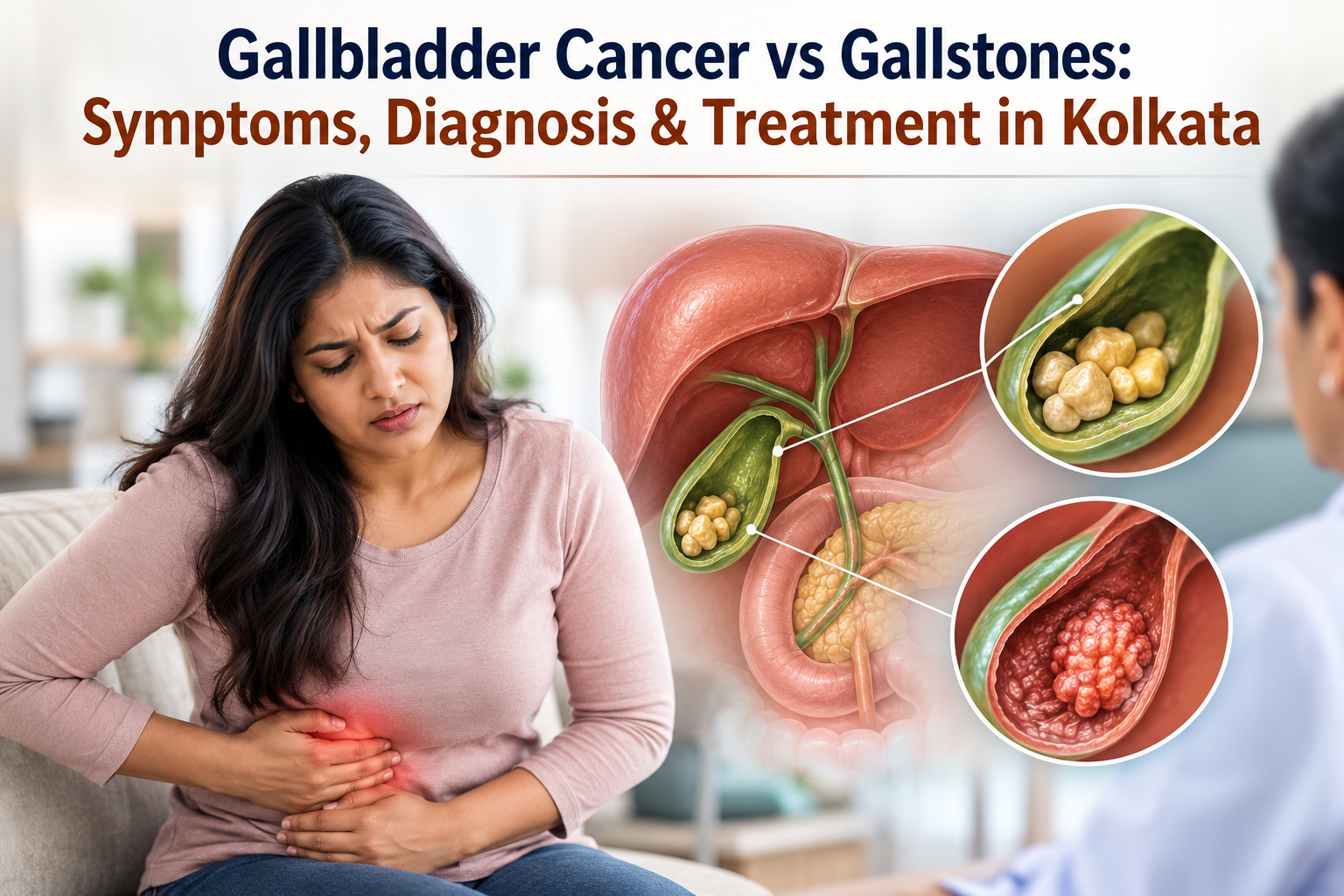
Gallbladder Cancer vs Gallstones: Symptoms, Diagnosis & Treatment in Kolkata
A person visits a doctor for recurring pain beneath the right ribs. An ultrasound shows gallstones. Surgery is discussed, and the family assumes the problem is straightforward. But what if the same scan also mentions irregular gallbladder wall thickening, a polyp or a suspicious mass?
That small difference in a radiology report can change the next steps considerably. Gallstones are common, and most people who have them never develop gallbladder cancer. Yet gallbladder cancer can sometimes remain unnoticed because its early symptoms overlap with ordinary gallbladder disease.
For patients in Kolkata, understanding the difference between gallstones and gallbladder cancer is useful not because every episode of abdominal pain suggests cancer, but because certain findings deserve closer investigation before treatment decisions are made.
This guide explains what distinguishes these conditions, which symptoms need attention, what an ultrasound can and cannot establish, and when a surgical oncology opinion may be helpful.
Understanding the Gallbladder and Why Problems Develop
The gallbladder is a small, pear-shaped organ situated beneath the liver. Its primary function is to store bile, a digestive fluid produced by the liver. When food enters the digestive system, bile helps the body digest fats.
Gallstones develop when substances within bile form hardened deposits. They may contain cholesterol, bilirubin or a mixture of materials. Some people have a single stone, while others have several.
Many gallstones remain silent. They may be discovered during an ultrasound performed for an unrelated reason. Others cause pain when a stone temporarily obstructs the flow of bile.
Gallbladder cancer is different. It begins when cells in the gallbladder develop abnormal changes and grow uncontrollably. As the disease progresses, it may involve deeper layers of the gallbladder wall and nearby structures.
Because the gallbladder lies close to the liver and major bile ducts, determining the precise extent of a suspicious tumour is especially important when planning treatment.
Gallstones vs Gallbladder Cancer: Key Differences
Symptoms alone cannot reliably distinguish these two conditions. The following comparison explains the general differences without replacing a medical assessment.
| Feature | Gallstones | Gallbladder Cancer |
|---|---|---|
| Nature | Hardened deposits within the gallbladder or bile ducts | Malignant growth arising from gallbladder tissue |
| Frequency | Relatively common | Much less common |
| Pain | May cause episodes of upper abdominal pain | May cause persistent pain, but can be silent early |
| Jaundice | Possible with bile duct obstruction | Possible when cancer obstructs bile drainage |
| Weight loss | Not a typical direct feature of uncomplicated stones | May occur, especially with more advanced disease |
| Diagnosis | Usually ultrasound and clinical assessment | Imaging, staging investigations and tissue assessment when appropriate |
| Treatment | Observation or gallbladder removal, depending on symptoms and complications | Stage-dependent cancer treatment, potentially including surgery and systemic therapy |
A person can have gallstones and cancer at the same time. However, the presence of gallstones alone does not establish a diagnosis of malignancy.
Can Gallstones Turn Into Gallbladder Cancer?
This is one of the most common concerns after gallstones are discovered.
Long-standing gallstones are associated with an increased risk of gallbladder cancer, particularly in some populations. Chronic irritation and inflammation may contribute to this association. However, most people with gallstones do not develop cancer.
The relationship is therefore not as simple as saying that a gallstone will eventually become a cancerous tumour. A stone is not itself a malignant growth.
Risk assessment may consider several factors, including age, the appearance of the gallbladder wall, the presence of a suspicious mass, relevant medical history and certain gallbladder abnormalities.
Patients should not assume that every asymptomatic gallstone requires removal to prevent cancer. Equally, a suspicious imaging finding should not be dismissed merely because gallstones are also present.
Symptoms That Deserve Closer Attention
1. Persistent Pain in the Upper Right Abdomen
Gallstone pain commonly occurs in the upper abdomen, sometimes beneath the right ribs. It may begin after eating and can last from around half an hour to several hours.
Gallbladder cancer can also cause upper abdominal discomfort. The pain may become persistent as the disease progresses. However, the pattern of pain alone cannot reliably determine whether cancer is present.
Pain that is severe, prolonged or associated with fever, vomiting or jaundice requires prompt medical assessment.
2. Yellowing of the Eyes or Skin
Jaundice develops when bilirubin accumulates in the body. It may be accompanied by dark urine, pale stools or itching.
A gallstone blocking the common bile duct can cause jaundice. A tumour involving the biliary system can also obstruct bile flow.
Because these causes require different management, new jaundice should be assessed urgently rather than treated as ordinary acidity or indigestion.
3. Unexplained Weight Loss
Losing weight without trying can occur for many reasons. However, noticeable weight loss accompanied by persistent abdominal symptoms, reduced appetite or jaundice deserves investigation.
Weight loss does not prove that someone has cancer. It is one part of the overall clinical picture.
For a detailed explanation, read our article on unexplained weight loss as a possible cancer warning sign .
4. Loss of Appetite and Early Fullness
A patient may notice that meals have become less appealing or that eating small portions causes discomfort. Such symptoms can occur with many digestive disorders.
When appetite changes continue alongside other unexplained symptoms, a doctor may recommend further evaluation.
5. Fever, Nausea or Vomiting
Gallbladder inflammation and bile duct infection can produce fever, nausea and vomiting. Some patients with gallbladder cancer may also experience these symptoms.
Fever with significant abdominal pain or jaundice can indicate a serious biliary complication and should not be ignored.
What If an Ultrasound Shows Gallbladder Wall Thickening?
The phrase “gallbladder wall thickening” can cause understandable concern when it appears in a scan report. But it is a description of an imaging finding, not a diagnosis of cancer.
The gallbladder wall may appear thickened because of inflammation, infection, liver-related conditions and other non-cancerous causes. Cancer is one possible explanation, particularly when imaging identifies irregular or focal thickening with other suspicious features.
The distinction depends on the appearance of the abnormality, associated findings and the patient’s clinical condition.
If the report mentions a suspicious mass, irregular focal thickening or possible involvement of nearby tissue, additional imaging or specialist evaluation may be recommended.
The correct response is not to assume the worst, but to understand what the radiologist has identified and whether further investigation is necessary.
Can Gallbladder Cancer Be Missed on Ultrasound?
Ultrasound is frequently the first investigation used for gallbladder complaints. It can identify gallstones, wall changes, fluid around the gallbladder and certain masses.
However, ultrasound does not detect every abnormality with equal accuracy. Small lesions, difficult anatomy or inflammation can complicate interpretation.
If clinical or imaging findings remain suspicious, the treating doctor may recommend contrast-enhanced CT, MRI or MRCP, or other appropriate investigations.
These tests can help clarify the relationship between the gallbladder, liver, bile ducts and surrounding structures.
A normal or inconclusive initial scan should therefore be interpreted alongside symptoms, examination findings and other relevant investigations.
How Is Gallbladder Cancer Diagnosed?
Diagnosis usually begins with a review of symptoms, medical history and imaging. The specialist then decides whether additional investigations are required.
Abdominal Ultrasound
Ultrasound may identify gallstones, gallbladder wall abnormalities, masses or dilation of the bile ducts. It is often the starting point rather than the final test.
Contrast-Enhanced CT Scan
A CT scan can provide more detailed information about a suspected tumour, its relationship with the liver, nearby lymph nodes and other abdominal structures.
MRI and MRCP
MRI can help characterize certain lesions. MRCP provides detailed images of the biliary and pancreatic duct systems without requiring conventional surgery.
Blood Tests
Liver function tests may identify abnormalities associated with bile duct obstruction. Other blood investigations may help assess the patient’s general health.
Tumour markers such as CA 19-9 or CEA may be considered in selected situations, but they cannot independently confirm or exclude gallbladder cancer.
Biopsy and Histopathology
Tissue examination is important in establishing a cancer diagnosis. However, a biopsy is not always performed before potentially curative gallbladder surgery.
In certain situations, doctors may avoid a pre-operative needle biopsy because of the tumour’s location, the planned operation or concerns about procedural risks.
The appropriate diagnostic approach should be decided by the treating specialist team.
What Happens If Cancer Is Found After Gallbladder Surgery?
Sometimes a gallbladder is removed because of presumed gallstones or inflammation, and the final histopathology report unexpectedly identifies cancer.
This is called incidental gallbladder cancer. It does not automatically mean that the original operation was performed incorrectly.
The next step is to examine the pathology report carefully. Important details may include how deeply the cancer has invaded the gallbladder wall, whether the surgical margins are involved and whether there are other high-risk features.
For a very superficial tumour, the original gallbladder removal may be sufficient in selected cases.
For deeper invasion, further imaging and additional surgery may be considered if the disease is operable and the patient is medically suitable.
This is an important situation in which review by a hepatobiliary or surgical oncology team can help determine whether additional treatment is necessary.
Does Gallbladder Cancer Always Require Major Surgery?
No. Treatment depends on the stage of the cancer and whether the tumour can be removed safely and completely.
For selected early cancers, surgery may offer a chance of long-term disease control or cure. More extensive disease may require a larger operation involving adjacent liver tissue and regional lymph nodes.
However, not every patient is a candidate for major surgery. When cancer has spread extensively or involves structures that cannot be safely removed, systemic therapy and supportive procedures may become more appropriate.
The decision must balance the expected benefit of surgery against its risks, the patient’s general health and the availability of other treatments.
What Are the Treatment Options for Gallbladder Cancer?
Surgical Treatment
Surgery may involve removal of the gallbladder and, in selected cases, adjacent liver tissue and regional lymph nodes. The exact extent depends on tumour stage, location and surgical assessment.
Chemotherapy
Chemotherapy may be used after surgery in appropriate patients or as part of treatment for advanced disease. The choice of medicines depends on the clinical situation.
Immunotherapy and Targeted Treatment
Certain patients with advanced biliary tract cancers may be eligible for immunotherapy or biomarker-directed treatments. Eligibility depends on disease characteristics, test results and the treatment setting.
Relief of Bile Duct Obstruction
When a tumour obstructs bile drainage, procedures such as biliary stenting may be used to relieve jaundice or associated complications.
These interventions may be important even when the cancer cannot be removed surgically.
For a wider discussion of cancer surgery and other treatment approaches, read our guide to cancer treatment in South Kolkata .
When Should You Consult a Surgical Oncologist?
A routine diagnosis of uncomplicated gallstones does not automatically require a surgical oncologist. Many patients can be appropriately managed by a general surgeon or gastrointestinal specialist.
However, a surgical oncology consultation may be valuable when investigations reveal:
- A suspicious gallbladder mass
- Irregular or focal wall thickening concerning for malignancy
- Possible invasion into adjacent liver tissue
- Histopathology confirming gallbladder cancer
- Uncertain findings requiring cancer-focused surgical planning
- A recommendation for complex gallbladder cancer surgery
The specialist can review the imaging and pathology, assess whether surgery is appropriate and discuss the need for multidisciplinary treatment.
If you are unsure which type of surgeon to consult, our article on the difference between a Surgical Oncologist and a General Surgeon explains the distinction.
Gallbladder Cancer Evaluation in South Kolkata
Patients living around EM Bypass, Mukundapur, Garia, Jadavpur, Kasba, Ruby, Santoshpur, Kalikapur and neighbouring parts of South Kolkata may require repeated hospital visits when undergoing investigations or treatment.
Access to imaging, pathology, surgical facilities and multidisciplinary cancer services can make coordination easier during a complex treatment journey.
Nevertheless, convenience should not be the only factor in selecting a specialist. For suspected gallbladder cancer, relevant hepatobiliary surgical expertise and careful treatment planning are especially important.
Patients seeking broader information can also review our guide to GI cancer specialist care in South Kolkata .
About Dr. Pallabika Mandal
Dr. Pallabika Mandal holds an M.Ch in Surgical Oncology from AIIMS New Delhi. Her surgical oncology practice includes gastrointestinal and hepatobiliary cancers, along with other cancer types.
Patients with suspected or confirmed gallbladder cancer may seek specialist evaluation to understand their imaging findings, pathology results and potential treatment options.
The consultation should focus on the individual diagnosis, the extent of disease, whether surgery has a role and whether additional oncology treatment is needed.
For information about Dr. Pallabika Mandal and her surgical oncology services, visit the official Dr. Pallabika Mandal website .
What Should You Bring to Your Consultation?
A well-organized set of medical records helps the specialist understand what has already been investigated and which questions remain unanswered.
- Abdominal ultrasound report
- CT or MRI reports, if available
- Actual scan images or digital imaging files
- Liver function and other blood-test reports
- Previous hospital discharge summaries
- Gallbladder surgery records, if previously operated
- Histopathology report, if the gallbladder was removed
- List of current medicines and medical conditions
If a report uses phrases such as “suspicious lesion”, “focal wall thickening” or “possible malignancy”, write down your questions before the appointment.
Questions Worth Asking Your Cancer Surgeon
- Does my imaging suggest ordinary gallbladder disease or a suspicious tumour?
- Are further investigations needed before deciding on surgery?
- Has the disease involved the liver or nearby structures?
- What is the purpose of the proposed operation?
- Will additional liver tissue or lymph nodes need removal?
- What are the possible complications?
- Could chemotherapy or another treatment be needed?
- Would a multidisciplinary cancer review be appropriate?
Our related article, 15 Questions to Ask a Cancer Surgeon Before Surgery , provides a more detailed consultation checklist.
Frequently Asked Questions
Can gallstones cause gallbladder cancer?
Gallstones are associated with increased gallbladder cancer risk, but most people with gallstones never develop cancer. The presence of stones alone does not mean malignancy.
How can I tell whether gallbladder pain is cancer?
Pain alone cannot distinguish gallstones from gallbladder cancer. A doctor may use examination, ultrasound and additional imaging to investigate suspicious findings.
Is gallbladder wall thickening always cancer?
No. Inflammation and other non-cancerous conditions can cause wall thickening. The appearance and associated findings determine whether further investigation is needed.
Can gallbladder cancer be detected through ultrasound?
Ultrasound can identify some suspicious abnormalities, but additional imaging may be necessary. Ultrasound alone cannot reliably establish every diagnosis or stage.
Can gallbladder cancer be discovered after surgery for stones?
Yes. Occasionally, cancer is identified when the removed gallbladder is examined by a pathologist. Further treatment depends on the pathology findings and stage.
Does every gallbladder cancer patient need chemotherapy?
No. Treatment depends on disease stage, surgical findings and the patient’s condition. Some patients may require surgery alone, while others benefit from additional therapy.
Should I consult a cancer surgeon for ordinary gallstones?
Usually, uncomplicated gallstones can be evaluated by a general surgeon. Surgical oncology review becomes more relevant when cancer is suspected or confirmed.
Can gallbladder cancer be treated successfully?
Treatment outcomes depend on the stage and extent of disease. Selected early-stage cancers may be treated with curative intent, while advanced disease may require systemic and supportive treatment.
Conclusion: The Finding That Matters Is Not Always the Stone
A diagnosis of gallstones is usually not a reason to fear cancer. Gallstones are common, and the overwhelming majority of people who have them do not develop gallbladder malignancy. For many patients, treatment is straightforward and depends on whether the stones cause symptoms or complications.
The situation changes when an investigation identifies something beyond ordinary stones: an irregular gallbladder wall, a suspicious mass, unexplained jaundice or a pathology report showing malignant cells.
These findings require a different level of assessment. The question is no longer simply whether the gallbladder should be removed. It becomes necessary to understand the nature of the abnormality, whether surrounding structures are involved and which treatment offers the most appropriate balance of benefit and risk.
For patients and families in Kolkata, the practical message is clear: do not interpret every gallstone as cancer, but do not overlook a suspicious report either.
A careful review of imaging, pathology and clinical findings can help distinguish a common gallbladder condition from a problem that requires specialist oncology management.
If cancer is suspected or confirmed, timely assessment by an appropriately trained specialist can help patients understand the diagnosis and make informed decisions about surgery and other treatment options.
Concerned About a Gallbladder Scan or Pathology Report?
If an ultrasound, CT scan or histopathology report raises concern about gallbladder cancer, specialist review can help clarify the next steps.
Dr. Pallabika Mandal provides surgical oncology consultations for patients requiring evaluation of suspected or confirmed cancers.
Medical References
This educational article draws on established information from the National Cancer Institute, NHS and NIDDK. It is not a substitute for an individual medical assessment.